Breanna
Castaneda
Art
History
Terry
Long
3
November 2013
The Great Picasso and Matisse
Two of history’s most influential
and innovative artists of their era, Pablo Picasso and Henri Matisse became two
supreme sources of inspiration for many aspiring artists of the present time.
Recognized today as two of the greats, together they paved the way for the
world’s modern artist, exposing new and unique approaches to painting, drawing,
sculpture and so much more. Though they differed considerably, each was able to
learn and grow from what some describe as their personal rivalry- although both
maintained a middle ground of respect for one another.
Though they excelled majorly in
painting, Picasso and Matisse held similar styles in drawing as well. Since
drawing is “the most direct expression of an artist’s thoughts”
(metmuseum.org), it’s hard not to feel like you’ve just witnessed a raw and
uncomplicated insight into the minds of these great artists. They exemplified a
unique understanding of form and shape and were able to capture the essence of
the subject’s being. Both had similar drawing techniques, preferring to work in
elegant and un-shaded lines. Their precise line drawings often described
simplified forms of female figures. These drawings helped both artists pin
point and work out compositional and stylistic complications encountered while
working on their piece.
Because drawing is such an important
part of understanding the fundamentals of shape and form, its no surprise that
Picasso and Matisse were able to develop transformational techniques. For
example, both utilized different variations of line weight when drawing. Their
lines became bolder throughout the years; in some pieces we see the line weight
switch to a heavier and thicker line. This line variance created forms that
although devoid of detail, were filled with a unique unpolluted essence of
truth to them. The forms held a sculptural appearance, which makes sense
considering Picasso’s excellence in sculpture. In fact, Matisse was inspired
and intrigued by Picasso’s style of cubism and led him to produce drawings and
compositions with geometric structure to them.
Although both were very similar,
Picasso’s enigmatic personality led him to delve much more in experimentation
with drawing than Matisse. He became fascinated with drawing with light, using
cameras and small lights to produce works that although fleeting, were captured
via photograph. Picasso’s energy and excitement is expressed in many of his
light drawings, they capture the entire frame with seemingly senseless swirls.
This innovation does not detract from the fact that although made with light,
these drawings still capture his noticeable style and preference for simplified
clean lines and understanding of the relationship between space, form and
shape.
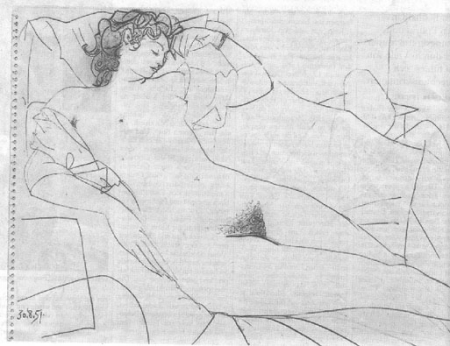
Odalisque, Picasso
pencil sketch, 1951

Face and Dove, Picasso
line drawing 1949

Themes et Variations, Matisse
line drawing, 1941

Patitcha Souriante, Matisse
line drawing, 1947
Image Sources
"97-picasso-or-breker." 97-picasso-or-breker. N.p., n.d. Web. 13 Dec. 2013
"Inside Matisse Drawing." Inside Matisse Drawing. N.p., n.d. Web. 13 Dec. 2013

No comments:
Post a Comment