Breanna
Castaneda
Art
History
Terry
Long
Artemisia Gentileschi and Jacques-Louis David
Artemisia Gentileschi was a female,
Italian Baroque-style painter and is still considered today to be one of the
most accomplished painters of her generation following the works of Caravaggio.
In an era where female painters were not easily accepted by artistic
communities or patrons, Artemisia ultimately became the first female painter to
be accepted by the Accademia di Arte del Disegno in Florence, Italy. Later, in
the late eighteenth century, Jacques-Louis David embodied a new style of
painting not seen before. This new style came to be known as Neoclassicism,
marking a change from the current Rococo style of painting and introducing a
preference for classical influences.
While both were very accomplished,
they were from different eras and different styles. Artemisia referenced images
of strong women of biblical and mythological origin. In her first painting,
“Susanna and the Elders”, a young girl, naked, vulnerable and distressed is
sexually harassed by her two assailants- the elders. This painting reflects the
Baroque-era influence in its drama and in its appeal to the viewer’s emotion.
In another piece Artemisia has depicted Judith, a female figure in Christianity
who signifies overcoming Satan and fleeting through Hell, violently severs
Holoferne’s- a general in the Roman Empire. This painting echoes the Baroque
style as Artemisia manipulates light amongst heavily darkened, pigmented colors
and her inclusion of biblical figures offers a dramatic flair to the painting.
After the Baroque era artists
entered a period known as Rococo. This period placed emphasis on lighter,
pastel color choices rather than the darker tones of the Baroque period, and
paintings often depicted frivolity amongst the subjects. Soon to follow the
Rococo period, Neoclassicism took up. In Neoclassicism the emphasis is most
stressed on form, proportion, a contained emotion and differs considerably form
predecessors Baroque and Rococo intricate ornamental design- scenes often kept
simple and uncluttered. Jacques-Louis David re-invigorated classical austerity
and reflected ideas of his life during the transitioning period of the French
Revolution. One piece in particular, titled “The Death of Marat” (1793) was
designed to commemorate one of his comrades after he was brutally assassinated
in his own home. David painted Marat’s face and body glowing in a soft light,
his style reminiscent of classical art captured Marat mirrored as a Christian
martyr. David’s classical training in Rome is beautifully displayed in this
piece and Caravaggio’s influence is recognized, just as it is in Artemisia’s
work.

Susanna and the Elders, Artemisia Gentileschi
1610, oil on canvas
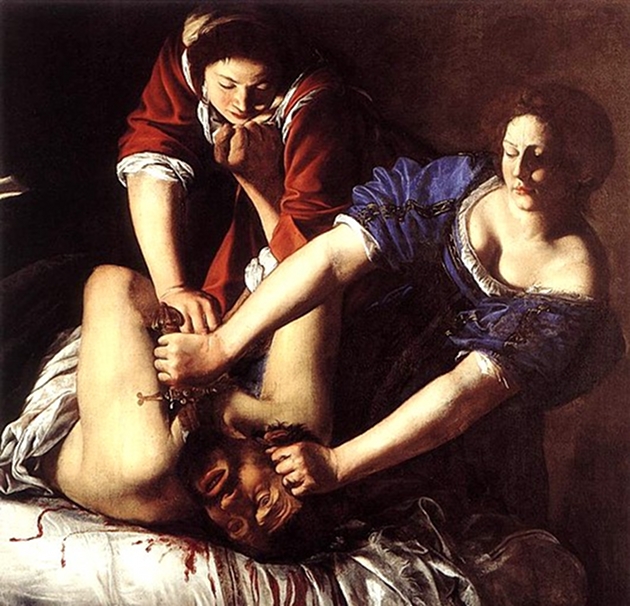
Judith Beheading Holofernes, Gentileschi
1611-1612, oil on canvas

The Oath of Horatii, Jacques-Louis David
1784, oil on canvas
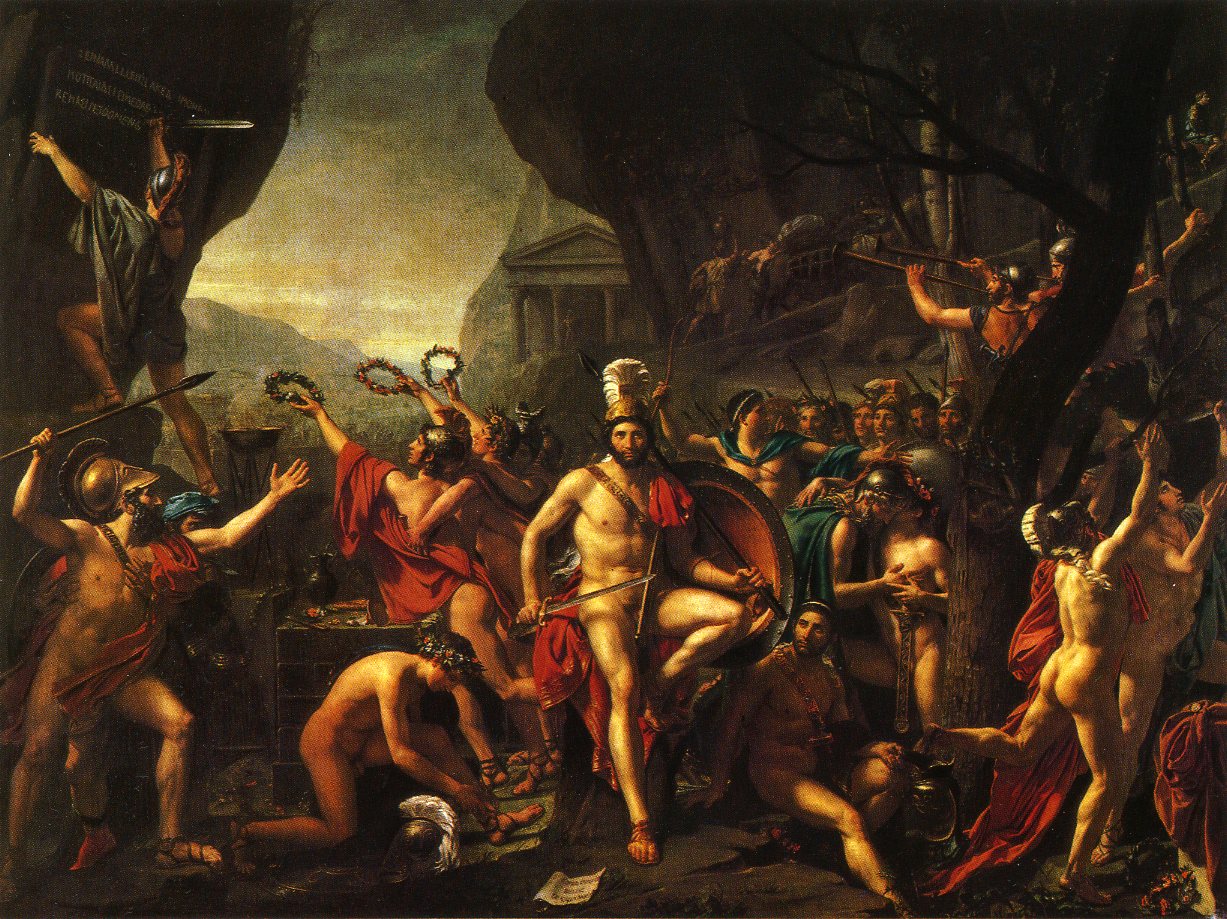
Leonidas at Thermopylae, Jacques-Louis David
(1799-1803), and (1813-1814), oil on canvas
Image Sources
"Artemisia Gentileschi." Wikipedia. Wikimedia Foundation, 12 Nov. 2013. Web. 13 Dec. 2013.
"The Oath of the Horatii, - Jacques-Louis David." The Oath of the Horatii, - Jacques-Louis David. N.p., n.d. Web. 11 Dec. 2013.

No comments:
Post a Comment