Breanna
Castaneda
Art
History
Terry
Long
11
December 2013
The Los Angeles Museum of Contemporary Art, MOCA
During my visit to the LA MOCA, I
came across the works of Jackson Pollock and Robert Rauschenberg. Jackson
Pollock was an American painter and major figure in the abstract expressionist
movement of the post World War II 1940s. Robert Rauschenberg was an American
painter and graphic artist whose early works anticipated the pop-art movement
of the 50s and 60s. Together, these men were two influential artists who took
conventional methods of painting and produced revolutionary techniques and
innovations for their contemporaries to follow with.
Pollock believed that an artist’s
journey toward making a work was every bit as important as the piece itself.
With that said, Pollock felt suffocated under the constraints of conventional
painting techniques and he wanted out. In an effort to refresh the situation,
he places his canvas on the floor and instead of acrylic or oil paint, reaches
for some thick-bristled brushes and sticks, and some household paint and
develops what is known today as “drip-painting”. Pollock’s drip technique
allowed him to work feverishly and with wild abandon. He was able to view his
work at all angles, he could feel the paint falling off the paintbrush as if it
fell straight from his very fingertips. Pollock demonstrated liberation and a
newfound emotional intensity in the creation process.
Rauschenberg developed works that
are referenced today as “combines”. Rauschenberg gathered all kinds of
non-traditional materials and objects and combined them in innovative
combinations with traditional forms of sculpture and painting. Developed a
series of “White Paintings” in which he utilized traditional monochromatic
painting, intending to reduce the painting to its most essential nature so the
viewer is subject to the pure experience of the colors. His combines are
representative of his efforts to bridge art and life, he brings non-traditional
objects in to create something with an air of surprise and mystery- it’s not
merely a sculpture or a painting anymore, it goes beyond into a whole new
level.
Pollock and Rauschenberg dared to
push the limits and in doing so fell into this world of liberation, wild
expression by any means and the freedom to let innovations fly. Both artists
had an innate ability to connect physically with their work, Pollock pacing
around his canvas board on the floor, fervently searching for where the next
splatter should appear next; and Rauschenberg, assembling a These men opened the eyes of every artist to
come; pushing conventionality and tradition out the window, they have shown the
world’s modern artist to be okay with disruption and confusion and allow
themselves to let go and fully experience their piece as they’re in the
creation process.

Mural, Jackson Pollock
1943, synthetic resin-based paint
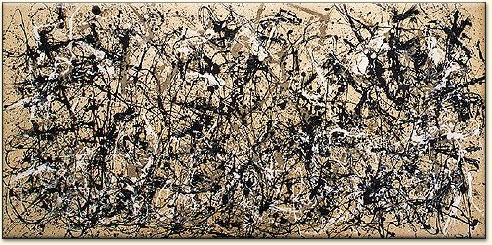
Autumn Rhythm, Jackson Pollock
1950, synthetic resin-based paint

Monogram, Rauschenberg
1959, random materials available and stuffed angora goat with tire
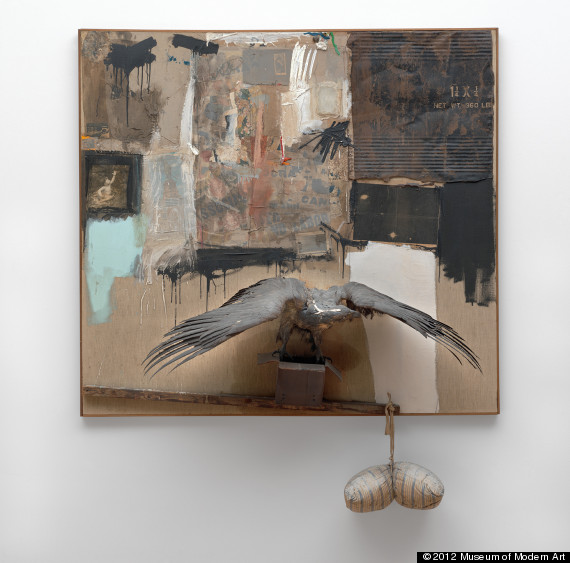
Canyon, Rauschenberg
1959, combination painting
Image Sources
"American Abstract Expressionism: Painting Action and Colorfields." American Abstract Expressionism: Painting Action and Colorfields. N.p., n.d. Web. 13 Dec. 2013.
Brooks, Katherine. "Robert Rauschenberg's 'Canyon' Donated To MoMA (PHOTO)." The Huffington Post. TheHuffingtonPost.com, 28 Nov. 2012. Web. 13 Dec. 2013.
"Cave to Canvas, Monogram - Robert Rauschenberg, 1959." Cave to Canvas, Monogram - Robert Rauschenberg, 1959. N.p., n.d. Web. 13 Dec. 2013.

No comments:
Post a Comment